Visit our Website

Learn more about Washington Food Coalition by clicking here.

Tuesday, March 4, 2014


Tri Cities Food Bank
By Stephanie Kardos


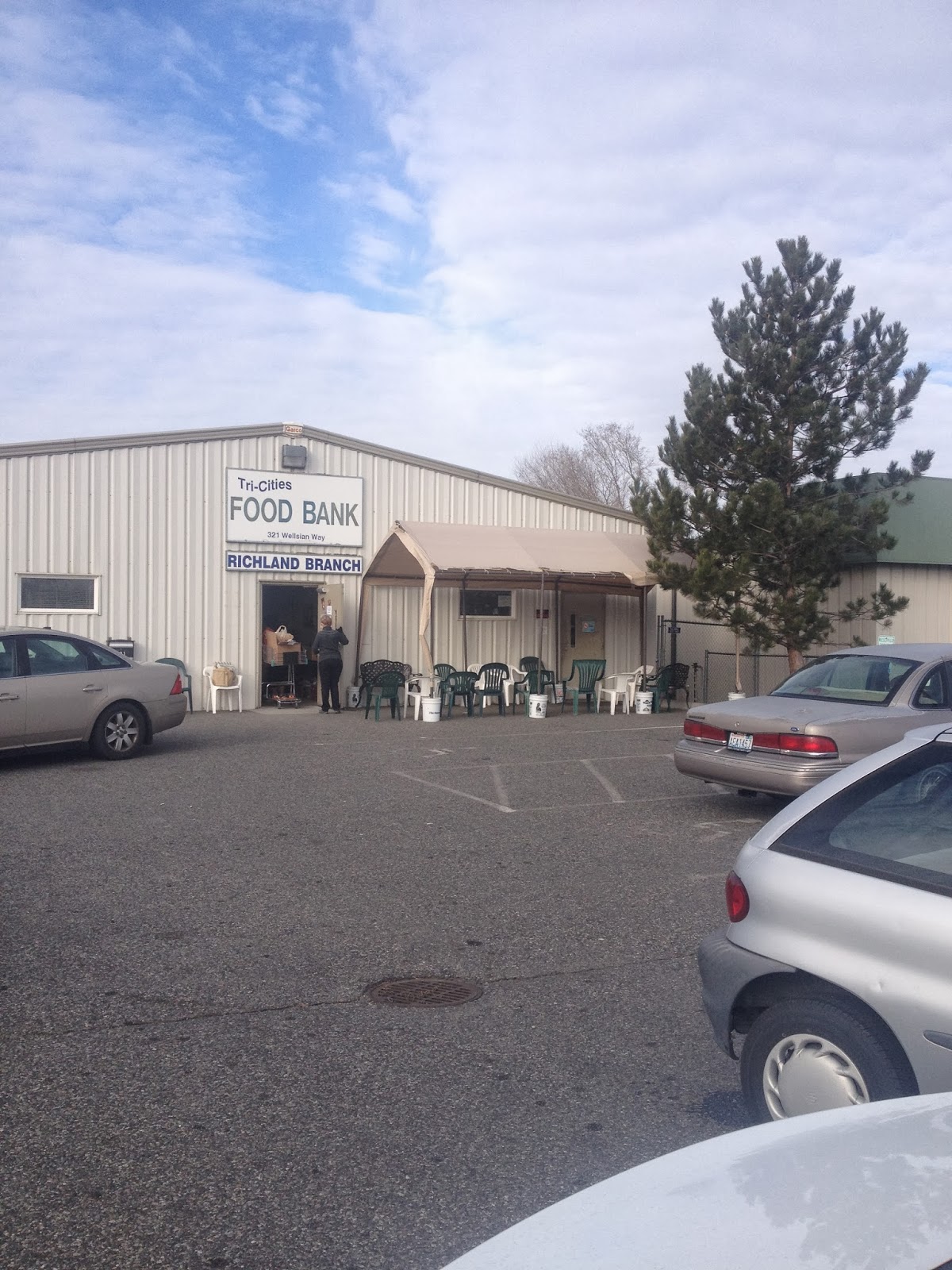
During our trip to Eastern Washington, we visited the Richland branch of the Tri-Cities Food Bank.  There we met with John Neill, he manages all three of the food banks in the Tri Cities: Kennewick, Richland and Benton City. After our meeting with John, he gave us a tour of the food bank.


The Tri-Cities Food bank was founded in 1974, by the United Way.  In 2010 they served more than 125,000 individuals representing approximately 33,000 families.  The Food Banks provides emergency food to the needy residents of Richland, West Richland, Kennewick, Finley, and Benton City. The Kennewick location serves approximately 53% of the people helped.  The Richland location serves approximately 33% and the Benton City serves approximately 14%. On average more than 15 tons of food were distributed weekly, and about 40% of the people served by the Food Bank are children.


Needy families may receive food as often as once every two weeks. At each visit, a family is provided with up to a week’s supply of groceries.  Families receive a variety of groceries, including: meat, eggs, margarine or butter, canned goods, rice, beans, flour, pasta products, seasonal fresh fruits and vegetables, and miscellaneous donated foods and supplies. In addition, an abundance of bread, rolls, and other bakery products are available. The Tri Cities Food bank is an all volunteer run nonprofit. This organization has more than 100 volunteers who have donated more than 30,000 hours collecting and distributing food to low-income people. Their volunteers collect food 365 days of the year.  To learn more visit : http://www.tricitiesfoodbank.org/

Summer and Afterschool Meals Funding Opportunity from UWKC

United Way of King County is pleased to announce a funding opportunity for organizations working to increase participation in Summer and Afterschool Meals.  In 2014, United Way of King County will award up to $300,000 to increase participation in the federally funded Summer and At-Risk Afterschool Meals Programsas well as 75 Campaign Corps Members to provide summer staffing, outreach, and programming assistance. 
 
Click here to view the Request For Proposal. 
 
Background
The Summer Food Service Program (Summer Meals) is a federally funded child nutrition program which provides reimbursement to local organizations that provide free, nutritious meals to low-income children and teens when school meal programs are not available
 
National and local research shows that this program is underutilized due to several factors: 
  • Lack of awareness about sites
  • Too few sites
  • Access / transportation to sites
  • Not having activities or incentives that engage kids and teens 
 
The At-Risk Afterschool Meals Program is part of the Child and Adult Care Food Program (CACFP), which offers federal funding to afterschool programs that serve a meal or snack to children in low-income areas. This new program is widely underutilized in our community and could provide a hot lunch or supper to thousands of King County children.  
 
Grant Funds
  • Grant funds will help organizations expand access to, and participation in, USDA-supported summer and afterschool meals programs.
  •  Funds may be used either by current meal sites or sponsors to help them expand capacity or increase the number of operating days; or they may be used to help establish new sites.
  • Eligible expenses may include (but are not limited to) equipment, activities, personnel, incentives, and marketing materials. Funds may not be used to provide food to kids.
  • Organizations can apply for up to $5,000 per site ($60,000 maximum award per agency).
 
Million Meals Campaign Corps
Campaign Corps members will be summer interns who are trained by United Way of King County and granted to sites/sponsors to perform outreach activities, create and run programs to engage children and teens, collect and track data, and assist with site management. Campaign Corps Members will be available between June 17, 2014 – August 29, 2014.
 
Contact Informations
For more information on the Summer Meals or Afterschool Meals programs visit: https://www.k12.wa.us/ChildNutritionor email BasicNeeds@uwkc.org.
 
Application Due Date
Applications will be reviewed on a rolling basis between March 10 - May 15, 2014. Agencies are encouraged to apply early. Applicants will receive a status update within 4 weeks of submitting their application.
 
Click here to view the Request For Proposals. 

Monday, March 3, 2014

Lessons on Cultural Competency

by Sariga Santhosh, Development Assistant

February was Black History Month.  On February 26, in addition the conversations happening all over the country to celebrate African American contributions throughout history, I had the opportunity to attend Conversations on African American Culture in King County at the Northwest African American Museum. Co-hosted by the Seattle Office of Emergency Management and the Office of Public Health, this cultural awareness event sought to build community relationships by informing emergency service providers and educators better ways to serve vulnerable populations in the event of a disaster.

The afternoon’s agenda featured lively discussions with panelists from communities in Seattle, who brought different perspectives to the issue of African American race relations. Panel members included a recent high school graduate from Auburn, award-winning poets and authors, and business owners, including the owner of Seattle’s only African American bookstore in Columbia City. The audience shared experiences about growing up in Seattle, culture shock when dealing with the city’s homogeneous white population, prevalence of racism despite the city’s liberal image, and exclusion from important conversations, to name a few stories.

  During the complimentary working lunch, event attendees got the chance to reflect more by answering interesting questions like:
“Why do black teens seem angry?” “
“What are some best practices to teach volunteers cultural competency when dealing with African American clients?”
“Are churches still the best way for emergency service providers to engage with African American communities?”

I learned a few things that day. Despite Seattle’s reputation as a progressive and forward-thinking place, the city’s history with race relations closely mirrors that of the rest of the country. Districts used to be very racially polarized. Communities were built on race and so segregated that the CD (known today as the ‘Central District’) used to stand for the ‘Colored District’ not too long ago. In the 1960s, 90% of Seattle’s population shared European ancestry. Today, that number is down to 80%, indicating some progress in diversity. However, both panelists and audience members still feel that “black is leaving Seattle.”

These days, it’s not institutional racism keeping Seattle’s African American population from better integrating into mainstream society. Gentrification, the rising costs of living, limited awareness of resources, and lack of a community have forced several vulnerable ethnic populations to relocate to areas like Renton and Tacoma. Places for communal gatherings and other safe havens are quickly disappearing. For several ethnic minorities, Seattle remains a “small town in a big city.”

My biggest lesson learned was that community building requires community buy-in. The historical pattern of excluding the African American voice from the important conversations that affect them has resulted in the distrust and fear of using the community resources mobilized to help them. Many African American clients believe their race is a barrier when it comes to navigating the emergency services system. Instead, they turn to community for resources and support. As one panelist noted, “I’ve created my own black world.”

Candid conversations, like ones at this event, are important in repairing broken relationships within communities and building bridges between minority populations and emergency service providers. Before having the conversation about how to deal with clients in an emergency, service providers need to venture out into the community and meet the people they serve. Clients want the same chance as anyone else to go through life without the stigma associated with their social group or culture. It is by making a place at the table for those who were once excluded from it that trust is won back.


FRAC Update: A Good Week for Children's Nutrition and Health


A Good Week for Children’s Nutrition and Health: Five Things You Should Know 

  1. The early childhood obesity rate is down. A new federal report shows a significant reduction in the obesity rate among children ages two to five, falling from 13.9 percent in 2003-4 to 8.4 percent in 2011-12.
  2. More money for fruits and vegetables in WIC. The final rule (pdf) on the new WIC food packages, released today by the U.S. Department of Agriculture, strengthens the WIC food package even further by implementing the original Institute of Medicine (IOM) recommendation to provide the full $8 in fruits and vegetables per month for children, a boost from the current $6 benefit. It’s estimated that this will result in an additional $1 billion in fruits and vegetables for low-income young children over the next 10 years.
  3. WIC rule contains even more gains for nutrition. In the rule, USDA also increased dairy options by including yogurt and increased whole grain options by including whole grain pasta. Overall, these and other improvements build on initial successes of the new WIC food packages in reducing obesity and improving nutrition among low-income women, infants, and children.
  4. More improvements to the school nutrition environment. Earlier this week, USDA Secretary Tom Vilsack, along with First Lady Michelle Obama, announced proposed guidelines (pdf) for local school wellness policies that will further improve the school nutrition environment for children. When peer pressure and stigma drive low-income students to purchase less healthy “competitive” foods, instead of eating healthy school meals, they lose out nutritionally in a much bigger way than their more affluent peers, and their families lose financially. 
  5. Community Eligibility is coming. Mrs. Obama and Secretary Vilsack also highlighted the upcoming national rollout of Community Eligibility, which has been proven to increase significantly the number of children eating school meals in low-income schools. Both FRAC and USDA have a series of resources on their websites to help states and advocates get ready for this implementation.
To learn more about the impact of the new WIC rule and other new nutrition improvements for schools, visit FRAC’s website.

Thursday, February 27, 2014

Our Visit to Second Harvest


Our Visit to Second Harvest
By Stephanie Kardos


At the beginning of February we got to visit Second Harvest distribution center and food bank in Spokane.  We went to their monthly meeting with all the local food banks and had a tour of the distribution center.


When we arrived we had a meeting with Sherman Reese and learned about “Feeding Washington”. Feeding Washington was created by a collaboration from Food Lifeline and Second Harvest to increase the amount of free food available to more than 500 food banks, meal centers and other hunger-relief programs that are feeding 880,000 hungry people each year throughout the state.  


Sherman used to be a farmer and now he works with farmers to get fresh food delivered to the Second Harvest Distribution center and out to food banks and meal programs.


 After talking with Sherman, we attended the 2nd Harvest February meeting with all the local food banks. At the meeting there were guest speakers from the St Joseph Family Center and Serve Spokane. Then we took a tour of the Second Harvest distribution center.


Owen Esperas, the Second Harvest Director of Warehouse Operation Manager, eagerly showed us around the warehouse and gave us background on Second Harvest.  Second Harvest has been leading the hunger relief network in the region since 1971. 


They distribute 2 million pounds of free food each month to help people in need in 26 counties throughout Eastern Washington and North Idaho.  The facilities are modern, clean and very organized. 


Owen was proud to show us the flags that represent the Food Safety awards they won for the last 3 years.


Owen also showed us the volunteer area where there is a lounge and café area as well as a conveyer belt and sorting room, so the volunteers can sort out and repackage food.


He told us a cute story about some of their senior volunteers and how competitive they can get while sorting produce. Second Harvest has more than 2,500 volunteers assist with ongoing food sorting, bulk food repackaging, general office needs, food drives and other special events held throughout the year.  For more information on Second Harvest in Spokane please visit there website:
www.2-harvest.org


Wednesday, February 26, 2014

AHNC Update on Anti-Hunger Program Initiatives

AHNC Logo
2014 Legislative Session - Week 4
Anti-Hunger and Nutrition Coalition  

Legislative Session Update - February 25, 2014  

Senate Budget Proposal

The Senate Majority Caucus Supplemental Budget proposal was released yesterday afternoon at a news conference. Here's how the AHNC Priorities fared in this budget:
   
Program
AHNC Request Amount
Senate Budget
Proposed Amount
Emergency Food Assistance Program (EFAP)
$1 million
$800,000 added dollars
Farmers Market Nutrition Program (FMNP)
$500,000
$0*
State Food Assistance (SFA)
$1.367 million
$0
Breakfast After the Bell
$101,000
(fiscal note for the bill)
$0
There is a $200,000 allocation to direct farm marketing that may have been meant to FMNP; folks are checking on this now. 


Issue Updates 

Emergency Food Assistance Program (EFAP):

It was great to see funding for EFAP included in the proposed Senate Budget.  Food Lifeline issued an alert on the $1 m EFAP funding request.  

ActionClick here to respond to the alert and then send it to your networks.  It's a simple way to thank Senators for including funding in their budget and also send messages to Representatives about the need for added EFAP funding in their budget.      


Farmers Market Nutrition Program (FMNP): 

The WA Sustainable Food and Farming Network is sending out alerts asking members to call the 18 Senators that sit on Ways and Means and have not yet signed onto the FMNP letter. Same for the 19 Representatives on Appropriations that haven't yet signed. Legislator sign-on letters have been submitted to leadership in both houses.

Action: Check the House and Senate letters and if your legislator hasn't signed, please ask them to sign on.  And if they have signed, please thank them! 


Breakfast After the Bell:

The Breakfast After the Bell bill (HB 2536) was passed by the House with a vote of 67 to 31 last Tuesday. The bill now goes to the Senate Early Learning & K-12 Education Committee, which had approved a version of the bill several weeks ago. So far, no hearing or vote on the bill has been scheduled, but there is still time! We will continue to monitor and send out updates.


State Food Assistance (SFA):

The Children's Alliance developed a revised budget request for State Food Assistance last week, based upon budget realities and the anticipated impact of the Farm Bill "heat and eat" cut on 1/3 of WA households receiving Basic Food or SFA. The revised budget request is $1.367 m to begin 100% SFA benefits January 1, 2015. The change reduces the cost in the Supplemental but continues to position SFA to be fully funded in the 2015-17 biennium.  

Action: Please contact your members in either House, particularly those who sit theAppropriations and Ways and Means Committees. We still have our online message open so click here to send a message as well.  

We are also asking folks to submit Letters to the Editor in targeted media outlets around the state. Click here for information on the LTE campaign.


We will be in touch soon with information on the House budgets which is rumored to be released and heard tomorrow (Wednesday).

Orange
Follow us on
 Like us on Facebook  Follow us on Twitter 

Friday, February 21, 2014


Rescue Mission in Tacoma
By Stephanie Kardos


After the Winter Food Summit we had a chance to tour the Rescue Mission of Tacoma’s Good Neighbor Café.  At the Café free and healthy meals are served to low income and homeless individuals.  When we visited they were getting ready to serve dinner. 


In the kitchen volunteers were cutting up fresh veggies, setting out ice tea and getting the hot food ready.   The food is mostly donated and they strive for highly nutritious meals.  Also the kitchen volunteers have an opportunity to get some great job training skills.


We learned that the program was going on its 102nd year. In 1912, Led by Evangelist Gypsy Smith, a group of business leaders rented a hall in Tacoma.  Originally called The Tacoma Commons, homeless and struggling men could find food and shelter.


The Good Neighbor Café can be converted into a shelter for overflow guests, especially on cold nights. Due to the cold temperatures on the day of our tour, they expected over 150 men to be sleeping there in the evening. 


Besides the Mission’s main headquarters in Tacoma, there are 4 additional locations throughout Pierce County: Fife, Lakewood and Puyallup-Sumner. They serve men, women, families and children. The Rescue Mission serves more than 26, 000 healthy, nutritious meals monthly to people that would otherwise go hungry. 


They provide shelter to more than 450 people every night and many of the beds are occupied by children.  To learn more about the Rescue Mission in Tacoma visit their website www.rescue-mission.org